Stage Script
Genre comedy, family, drama
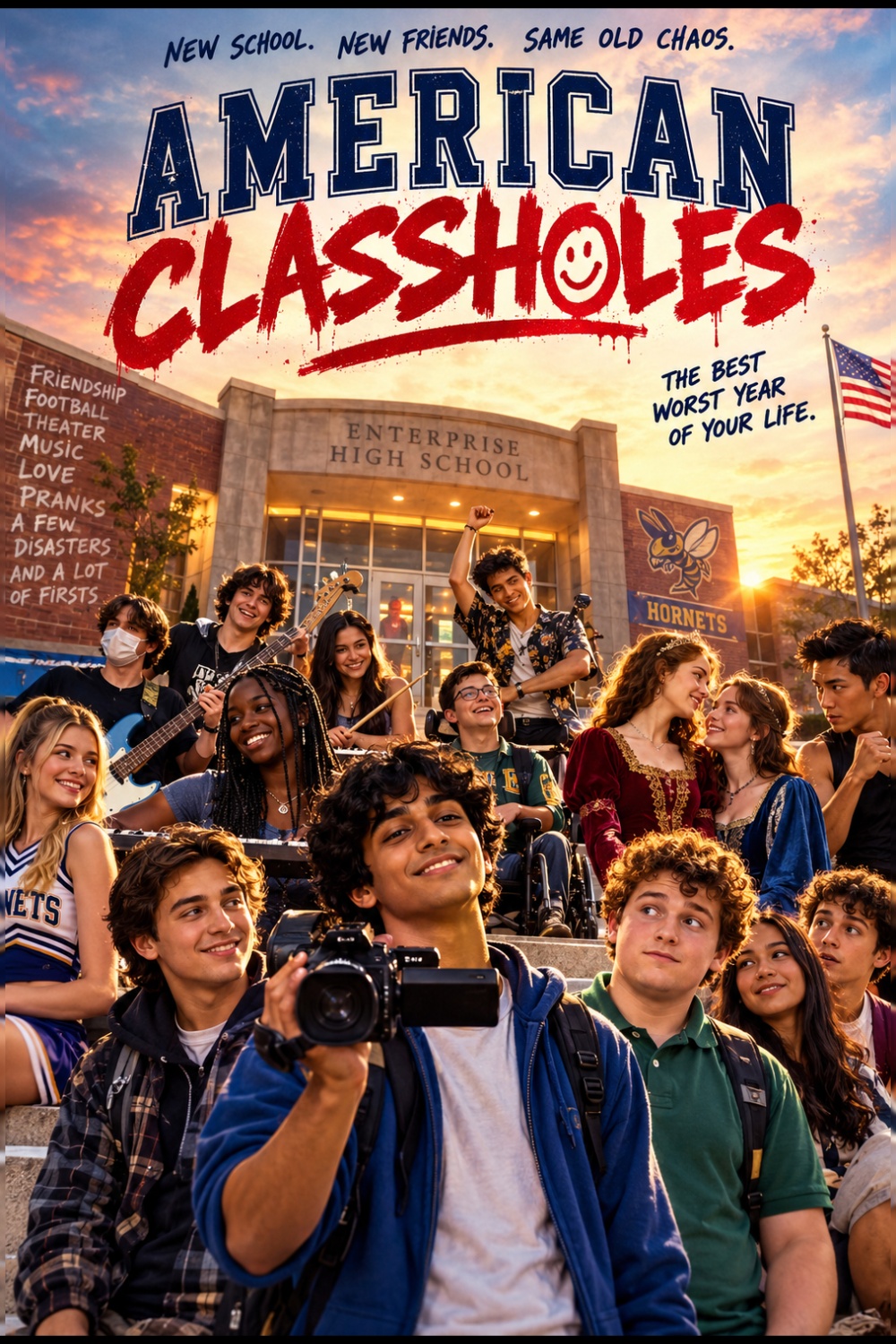
As a group of diverse freshmen navigate high school in Las Vegas, they discover that surviving bullies, friendships, romance, and teenage drama is only half the challenge—figuring out who they are is the real adventure.
High school is supposed to prepare teenagers for the real world. Unfortunately, nobody seems particularly prepared for high school. Set in Las Vegas, Nevada, American Classholes is an ensemble comedy-drama following a diverse group of freshmen at Enterprise High School as they navigate the unpredictable world of friendships, relationships, bullying, academic pressure, social expectations, and self-discovery. For these teenagers, freshman year is more than a new school experience. It's the beginning of a period when friendships are tested, identities are challenged, and seemingly insignificant decisions can have lasting consequences. Some students are determined to become popular. Others simply want to survive without attracting attention. Some are discovering love for the first time, while others are struggling to understand themselves. Athletes, musicians, aspiring filmmakers, theater performers, outsiders, and unlikely friends all share the same hallways, creating an interconnected world where one person's actions can unexpectedly affect another's life. At the center of the series is a large ensemble of students whose experiences reflect the humor, awkwardness, excitement, and emotional complexity of adolescence. Vijay, an Indian exchange student living with an American host family, arrives with expectations shaped partly by American movies. Armed with a camera and an enthusiastic imagination, he begins documenting his new school experience, hoping to discover the extraordinary stories hidden in everyday life. His filmmaking ambitions gradually lead him toward creative collaborations with his classmates, including producing a music video for a newly formed student band. Wendy, a painfully shy freshman, struggles with self-confidence and expressing herself. Her admiration for the more outgoing Lillian draws her toward the school's theater program. What begins as an opportunity to spend time with someone she likes becomes an unexpected discovery of her own acting talent. As their romantic relationship develops, Wendy learns that confidence isn't necessarily about becoming someone different, but about finding the courage to be herself. Rodney, a wheelchair user with a sharp understanding of football strategy, refuses to let others define his capabilities. His contributions to the school's football program earn him recognition, while his relationship with Tanya explores the everyday challenges and joys of young love. Their story addresses accessibility, independence, insecurity, and mutual understanding without allowing disability to become Rodney's entire identity. Meanwhile, a group of musically inclined students—including Jeddrah, Kenny, Brian, Lisa, and Jonathan—develops into a band. Their creative ambitions are accompanied by disagreements, embarrassing moments, and the realization that performing music is considerably more complicated than imagining themselves as rock stars. From writing their first original songs to preparing for their first live performance, their experiences capture the excitement and uncertainty of young artists finding their voice. Other students face challenges that are less visible. Carl, an awkward and frequently overlooked student, experiences the cruelty that can hide behind supposedly harmless jokes. His experiences raise questions about bullying, humiliation, retaliation, and the consequences of treating another person's suffering as entertainment. Emily struggles with the desire to be accepted by popular classmates, even when belonging to their social circle threatens the friendships and values that matter to her. Luke, a student trained in martial arts, must navigate relationships, personal discipline, and situations where restraint can be more important than physical ability. As the school year progresses, additional students bring their own experiences into the ensemble, including Maria, whose willingness to defend herself creates unexpected consequences, and Amir, a basketball player balancing athletic ambitions with family expectations and religious commitments. The students' stories unfold against the backdrop of Enterprise High School, where Principal Hudzick approaches education with an eccentric but sincere enthusiasm. His signature encouragement, “Shine Like the Star That You Are!”, reflects his belief that every student has something valuable to offer. Alongside the more pragmatic Vice Principal Worche and the school's teachers, he attempts to maintain order in an environment where teenagers routinely find inventive ways to create chaos. The school's Positive Student Movement introduces another dimension to the series, exploring how students respond to bullying, social pressure, and the responsibility of standing up for others. Even well-intentioned efforts can have unintended consequences, challenging students to consider the difference between what they mean to do and how their actions affect other people. Throughout the first semester, the freshmen experience the excitement and anxiety of entering a new social environment. Football games, classroom encounters, theater auditions, friendships, romantic discoveries, school events, and personal conflicts gradually connect characters who initially seem to have little in common. The second semester expands their world. New students arrive. Relationships evolve. Creative opportunities emerge. Old conflicts produce new consequences. Students who once remained in the background begin stepping forward, while others discover that popularity and recognition aren't necessarily what they imagined. The band moves toward its first public performance. Vijay explores filmmaking beyond simply recording his classmates. Wendy begins pursuing acting because she genuinely enjoys it. Rodney and Tanya discover new ways to understand and support one another. Emily faces increasingly uncomfortable choices about belonging and friendship. Rather than following a single protagonist or relying on one central conflict, American Classholes allows multiple storylines to develop and intersect organically. A seemingly minor hallway encounter may become the beginning of a friendship. A joke may have consequences nobody anticipated. A moment of embarrassment may eventually become a treasured memory. The series balances irreverent teenage humor with sincere emotional storytelling. Characters make mistakes, misunderstand one another, behave selfishly, fall in love, and occasionally do the right thing for entirely the wrong reasons. They are neither idealized role models nor exaggerated stereotypes. They are teenagers learning through experience. Disability, cultural identity, religion, family expectations, bullying, and social acceptance are woven naturally into the characters' lives rather than presented as isolated lessons. The series celebrates differences while recognizing the experiences that connect young people regardless of their backgrounds. The first season consists of 30 episodes covering the students' entire freshman year, with the first 15 episodes following the first semester and the remaining 15 exploring the second. The season culminates in an ambitious ensemble musical finale that brings the school's characters together in a celebration of the friendships, conflicts, discoveries, and absurdities that have defined their year. At its heart, American Classholes is about growing up in a world where everyone is trying to figure out who they are while pretending they already know. It's about discovering that the most popular person isn't necessarily the happiest, the quietest person may have an extraordinary talent, and the classmate everyone overlooks may have a story worth telling. Above all, it's about the friendships, mistakes, laughter, heartbreak, and unexpected connections that make high school unforgettable. Because sometimes the biggest lesson in high school has nothing to do with what happens in the classroom.
Writer - Director Eric R Velarde