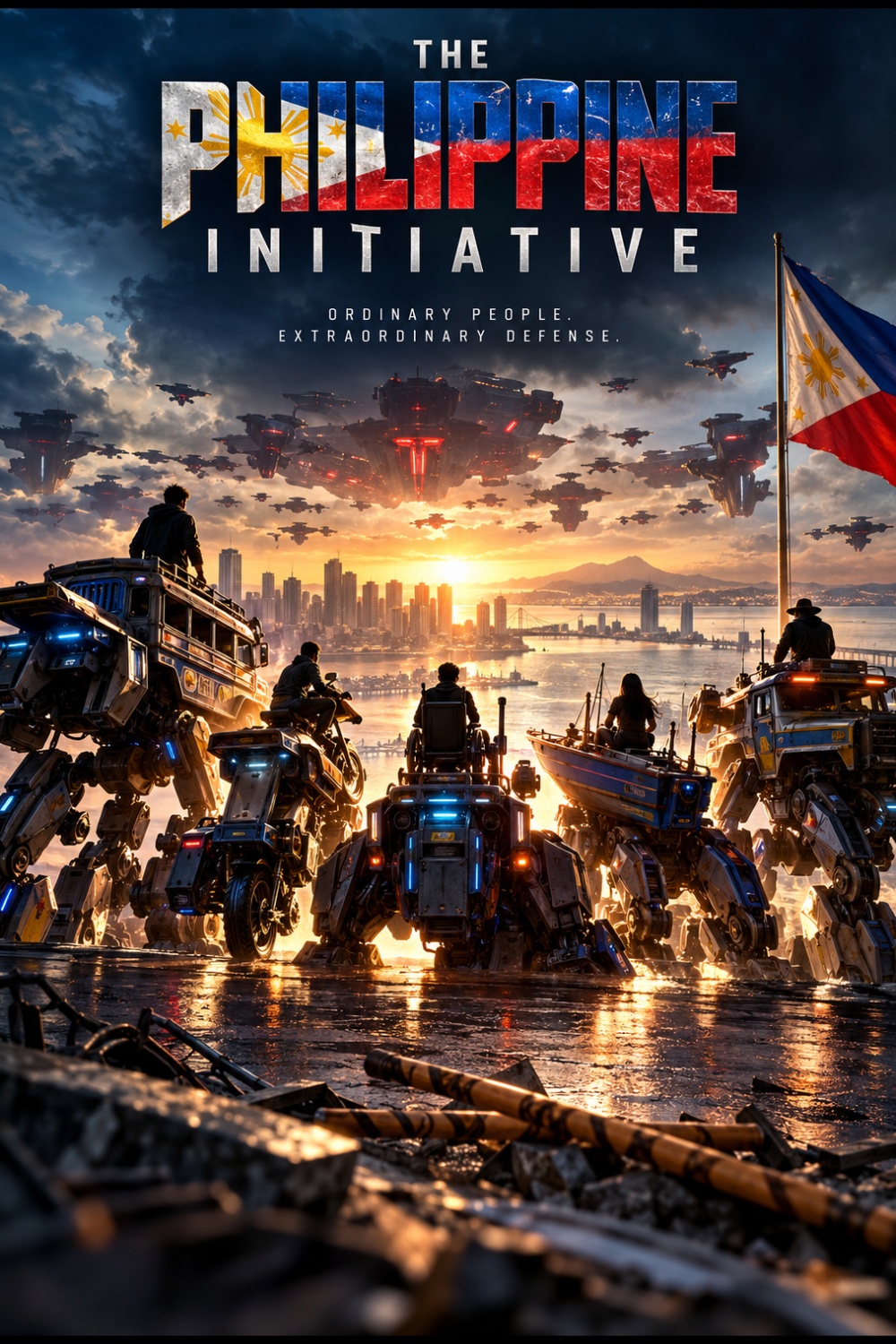
Stage Script
Genre action, sci-fi, adventure
When a powerful foreign military invades the Philippines, an unlikely team of ordinary Filipinos must master transforming civilian vehicles into combat robots and learn to fight as one to save their homeland.
When a powerful foreign military launches a coordinated invasion of the Philippines, the nation faces an overwhelming threat. Enemy warships, fighter aircraft, drones, and armored forces target strategic ports, military installations, and communications infrastructure. The Philippine Armed Forces mount a determined defense, but their conventional resources are stretched to the breaking point. Unknown to the invading forces, the Philippines possesses a secret defense program unlike anything the world has seen. **The Philippine Initiative** is an advanced technological defense system developed through private investment, engineering innovation, and support from the global Filipino diaspora. Created in cooperation with the Philippine government, the program transforms ordinary civilian transportation—including jeepneys, tricycles, buses, and utility vehicles—into sophisticated armored combat machines capable of defending the country. But the Initiative's greatest innovation isn't its technology. It's the people operating it. Ordinary People, Extraordinary Responsibility Six months before the invasion, a diverse group of Filipinos is recruited into a classified national defense program. Among them is **Miguel "Migs" Santos**, a hardworking jeepney driver struggling to provide for himself and his younger sister, **Aira**, a gifted teenage gamer. Their relationship is strained by financial pressures and Migs' belief that Aira spends too much time playing video games instead of helping around the house. One evening, Migs confiscates Aira's controller, only to become fascinated by the game himself. When Aira helps him complete a mission, their argument gradually turns into laughter and cooperation. Neither realizes that their unlikely partnership will eventually become essential to their country's survival. Other recruits include **Rico Alvarez**, a fast-talking delivery rider whose impulsive confidence frequently gets him into trouble; **Lea Navarro**, a brilliant but cautious engineer who prefers calculated decisions; **Mila Torres**, a compassionate nursing student determined to help others; and **Noel "Nox" Reyes**, a former firefighter who uses a wheelchair and struggles with the loss of his former role as a first responder. The group also includes **Lola Carmen Dela Cruz**, a spirited elderly woman whose father fought as a Filipino guerrilla during World War II. Though considerably older than the other recruits, Lola refuses to let age determine what she can contribute. Her humor, courage, and maternal warmth gradually make her the emotional center of the team. Each recruit joins for different reasons: financial security, opportunity, purpose, or the desire to make a difference. Under the leadership of **Commander Rafael "Raf" Villanueva**, engineer **Bianca Ramos**, and martial arts instructor **Dario Cruz**, they discover the true nature of the Initiative. The Machines Behind the Mission The recruits are introduced to a fleet of seemingly ordinary Philippine vehicles concealing extraordinary capabilities. With a single verified authorization from Initiative Command, each vehicle gains access to its advanced systems. In **Assault Mode**, the vehicles deploy concealed armor, integrated weapons, and enhanced mobility systems while retaining their recognizable civilian configurations. In **Robot Mode**, the vehicles physically transform into humanoid combat machines capable of operating conventional weapons and engaging enemies in close combat using technologically enhanced Eskrima sticks. The program also possesses a remarkable final capability: multiple robots can combine into a single enormous combat machine. However, the technology comes with a critical limitation. Each unit requires two operators working together: a Driver responsible for movement and physical control, and a Gamer responsible for targeting, defense, and tactical support. While Assault Mode can compensate for some coordination errors, Robot Mode demands near-perfect synchronization. Poor communication can cause a robot to stumble, expose itself to attack, or endanger civilians. The recruits soon discover that controlling these machines requires more than individual talent. They must learn to trust one another. Training exercises expose their weaknesses. Rico's impulsiveness clashes with Lea's analytical nature. Migs tries to control every decision, frustrating Aira. Other recruits struggle to anticipate their partners' movements. Dario introduces Eskrima training and demanding physical coordination exercises, including drills requiring recruits to intercept incoming water balloons with training sticks. The exercises initially produce more laughter and frustration than success, but gradually teach timing, restraint, and mutual awareness. Lola becomes an unexpected source of inspiration, reminding the younger recruits that courage is not the absence of fear, but the willingness to act despite it. Nox, meanwhile, begins to rediscover his purpose when he learns that the Initiative's advanced mobility technology may allow him to participate in rescue operations in ways he never imagined. The Invasion The Initiative's preparation is interrupted when an invading military force launches a devastating offensive against the Philippines. The enemy's objective is to seize a strategically important port, neutralize Philippine defenses, and establish control before international assistance can arrive. As conventional military units suffer mounting losses, the Philippine government authorizes the Initiative's deployment. Across the country, ordinary civilian vehicles suddenly transform into armored combat machines. Jeepneys become mobile weapons platforms. Tricycles deploy advanced defensive systems. Buses and other vehicles provide armored transportation and battlefield support. The unexpected appearance of these machines initially catches the invading forces off guard. Migs and Aira are assigned to protect a civilian evacuation corridor. When an enemy drone threatens a bus carrying evacuees, Aira hesitates to fire because civilians are dangerously close to the target. Her concern is justified, but the delay allows the drone to attack. Migs maneuvers his jeepney into the line of fire to protect the civilians. The resulting explosion leaves him critically injured. Aira is devastated. Although Migs survives, she blames herself for what happened. Her confidence collapses, and she begins questioning whether she belongs in the Initiative. During his recovery, Migs reassures her that he does not blame her. But his forgiveness cannot immediately overcome her guilt. Determined never to hesitate again, Aira later makes the opposite mistake during a training exercise, firing too quickly and nearly endangering simulated civilians. She must learn that sound judgment requires neither reckless aggression nor paralyzing hesitation, but the ability to recognize the right moment to act. A Different Kind of War As the invasion continues, the enemy commanders realize that the Initiative is far more dangerous than they anticipated. Initially dismissing the transformed vehicles as an unconventional defensive force, they adapt their tactics, employing coordinated missile attacks, artillery, aircraft, and electronic warfare to overwhelm the Initiative's units. Their intelligence officers also discover evidence of the encrypted authorization system controlling the vehicles' advanced capabilities. Rather than simply attempting to jam communications, they seek to compromise the system's authentication and transmit fraudulent lockdown commands that could restrict the Initiative's combat capabilities. Bianca and Raf race to protect the network while the teams continue fighting. At the same time, Raf confronts a weakness in his own leadership. His instinct to personally control battlefield decisions creates delays during a civilian evacuation. He gradually recognizes that the Driver/Gamer teams must be trusted to respond to changing conditions without waiting for constant instructions. Meanwhile, Rico and Lea begin to understand that neither instinct nor careful analysis is sufficient by itself. Their partnership improves when they learn to combine both approaches. Mila becomes increasingly important as casualties overwhelm the evacuation and medical facilities. Working alongside Nox, she helps coordinate rescues, stabilize the injured, and protect civilians caught between advancing enemy forces and the Philippine defenders. During a dangerous rescue operation, Nox initially feels powerless when a massive concrete obstruction traps civilians. Guided through his equipment's concealed capabilities, he activates a powered rescue exosuit integrated into his wheelchair. For the first time since his injury, Nox possesses the mechanical strength to move enormous obstacles and reach people he previously could not save. His enthusiasm briefly gets the better of him when he throws a heavy piece of debris farther than intended, nearly striking a nearby vehicle. The moment brings laughter amid the danger, but it also marks a turning point. Nox realizes that his value as a rescuer never disappeared. He simply needed a different way to serve. The Rise of the Robots As the invading forces intensify their attacks, Assault Mode alone becomes insufficient. The Initiative's vehicles are increasingly outmatched by coordinated airstrikes, armored assaults, and sustained enemy fire. The teams face a dangerous choice. They can continue fighting in familiar configurations, or attempt Robot Mode in actual combat despite their incomplete synchronization training. With little alternative, they transform. For the first time, the Initiative's vehicles unfold into towering humanoid machines. The battlefield changes dramatically. Armed with guns, missiles, defensive systems, and dual Eskrima sticks, the robots engage the enemy's conventional forces in ways their opponents never anticipated. But their early movements are awkward. Drivers and Gamers issue conflicting commands. Robots stumble and expose themselves to enemy fire. The operators must rapidly apply the lessons they learned during training. Gradually, their coordination improves. Migs, recovered enough to return to duty, reunites with Aira on the battlefield. Their relationship has evolved from constant arguments into a genuine partnership. Instead of trying to control every decision, Migs trusts Aira's judgment. Instead of allowing fear to dictate her actions, Aira learns to act with confidence and restraint. Together, they become a formidable team. The robots' unconventional appearance and combat capabilities also bring moments of humor, particularly through Rico, whose enthusiasm for transforming machines occasionally distracts him from the seriousness of the battle. Yet the enemy continues adapting. The Initiative's individual robots can disrupt enemy formations, but they cannot defeat the entire invasion force alone. The recruits must attempt their most ambitious maneuver. They must combine. One Machine, Many Hearts The Initiative's ultimate defensive capability requires multiple robots to physically connect into a single massive combat machine. The process is extraordinarily difficult. Each Driver/Gamer pair must synchronize internally while simultaneously coordinating with every other unit. Their first attempt fails. Conflicting movements destabilize the formation, leaving the robots dangerously exposed. Enemy forces recognize the opportunity and launch a concentrated attack. As the recruits struggle to regain control, Lola Carmen makes a courageous decision. Despite damage to her own unit, she holds a critical structural position long enough for the others to stabilize the formation and protect nearby civilians. Her actions buy the team the time it needs. Remembering their training, the recruits stop trying to control the entire machine individually. They begin listening. Anticipating. Trusting. For the first time, they operate as one. The combined mech rises. Its immense size and coordinated capabilities allow it to withstand the enemy's concentrated attacks and disrupt the invading forces' battlefield operations. Working alongside the Philippine Armed Forces, the Initiative begins turning the tide. The combined machine's dual Eskrima weapons become a striking symbol of Filipino martial tradition brought into a futuristic battlefield. But victory comes at a terrible cost. Lola's Last Rescue During the climactic battle, Lola's damaged mech suffers a catastrophic hit. An explosion engulfs her position. Her communications disappear. Her telemetry goes silent. The other recruits believe she has been killed. There is no time to mourn. The battle continues. Later, while searching the wreckage, Nox detects signs of life beneath the collapsed structure. He discovers Lola trapped inside her destroyed machine. She is alive. But she has suffered severe injuries, including shrapnel wounds and significant blood loss. Nox immediately recognizes the seriousness of her condition. Lola, characteristically stubborn, dismisses his concerns with humor. As the surrounding structure begins collapsing, Nox realizes that Lola cannot escape under her own power. He makes a difficult decision. Using an emergency transfer system, he gives Lola control of his powered wheelchair exosuit. Nox remains on the ground, unable to walk. Lola suddenly finds herself supported by the suit's powerful mechanical limbs. She stands. She walks. She discovers that she can lift objects far heavier than anything she could have managed before. Her delight is infectious. For a moment, her injuries seem almost forgotten. When Nox urgently shouts for her to escape, Lola indignantly asks whether he is shouting at her. Then she sees him stranded amid the wreckage. Without hesitation, she lifts him onto her shoulder and carries him to safety. The exosuit gives Lola the strength to escape the collapsing structure, and the two emerge from the smoke together. Their survival brings an enormous sense of relief. But the technology has only compensated for Lola's physical limitations. It has not healed her wounds. At the evacuation checkpoint, Mila notices the severity of Lola's bleeding and immediately calls for emergency treatment. Lola is taken into medical care while Nox remains behind, believing she has survived the worst. Victory and Sacrifice With the Initiative's combined forces disrupting enemy operations, the Philippine military launches a coordinated counteroffensive. Enemy aircraft are driven back, critical positions are recovered, and the invading command structure begins to collapse. The enemy's attempt to compromise the Initiative's authorization system is defeated through Bianca's intervention and the teams' continued coordination. Unable to secure its strategic objective, the invading force is compelled to withdraw. The Philippines has survived. Across the country, civilians celebrate the unexpected victory. The Initiative's surviving recruits return to their facility exhausted but relieved. They exchange stories, embrace their families, and begin searching for familiar faces. Among them, Nox looks for Lola. He expects to see her smiling, complaining, and reminding everyone that she is too stubborn to die. Instead, Mila approaches. Her expression tells him something is wrong. Despite the medical team's efforts, Lola succumbed to her injuries. The news spreads quietly among the recruits. Their celebration gives way to grief. Lola survived the explosion. She saved Nox. She reached safety. But her wounds were ultimately too severe. Her death reminds the team that even extraordinary technology cannot eliminate the human cost of war. A Legacy Worth Defending In the aftermath, the Initiative honors those who sacrificed their lives defending the Philippines. At a memorial ceremony, the surviving recruits gather before a photograph of Lola Carmen Dela Cruz. The woman who once seemed too old to belong among them has become one of their greatest heroes. Her courage inspired them. Her humor sustained them. Her sacrifice helped save their country. Migs and Aira stand together, their relationship transformed by everything they have endured. Rico and Lea, once constantly at odds, now share an unspoken understanding. Mila continues helping the wounded. Nox, forever changed by Lola's final act of courage, commits himself to continuing the rescue work they began together. Elsewhere, an older Filipino citizen watches news footage of Lola's heroism and considers joining the next generation of Initiative recruits. The program will continue. Not simply because the Philippines needs advanced weapons, but because its greatest strength has always been its people. **The Philippine Initiative** concludes with a nation discovering that its most powerful defense is not a machine, a weapon, or a single hero. It is the willingness of ordinary people to stand together when their country needs them most. **We don't fight alone.** --- Project Themes *The Philippine Initiative* combines large-scale science-fiction action with a distinctly Filipino story about family, resilience, national identity, and collective responsibility. Through its ensemble of drivers, gamers, engineers, medical workers, older citizens, and people with disabilities, the film challenges conventional definitions of heroism. Its transforming vehicles celebrate familiar elements of Philippine culture, while its use of Eskrima connects futuristic technology with the country's martial heritage. At its heart, the story is about people learning that their individual strengths become extraordinary when they trust one another. The film balances spectacle, humor, and emotional drama, presenting an accessible action-adventure with the potential to expand into additional stories, animated projects, games, and collectible merchandise.
Writer - Director Eric R Velarde